Building a High-Converting Ecommerce Store in 2026: The Ultimate Australian Business Guide
Did you know that 75.4% of Australian shoppers abandoned their carts in 2024 because of unexpected shipping costs or complex checkout flows? If you're feeling overwhelmed by platform choices or technical hurdles, you aren't alone. Building a high-performing ecommerce store in 2026 requires more than just a product list; it requires a results-driven sales engine. You likely agree that a basic website isn't enough to compete when local buyers expect instant shipping calculations and one-click payments.
For example, a high-end retailer like Volupto, which sells premium stone baths, relies on a bespoke digital experience to convey luxury and quality—something a generic template cannot achieve.
We've got you covered. This guide shows you how to transform your online shop into your strongest customer touchpoint by automating everything from inventory management to AusPost labels. You'll discover how to integrate StarTrack seamlessly and use the same conversion strategies that boosted our clients' revenue by 22% over the last 12 months. We're going to break down the exact steps to put an agency's expertise behind your business and reclaim your time through smart automation.
Key Takeaways
- Understand why a simple website is no longer enough and how to transform your ecommerce store into a high-performing multi-channel sales ecosystem.
- Identify the critical design and performance elements that guide Australian shoppers from their first landing straight to the checkout.
- Evaluate the true costs of DIY platforms versus custom builds to choose the right foundation for your long-term business growth.
- Navigate Australian Consumer Law and GST requirements with ease, ensuring your brand stays compliant while you scale.
- Discover how a "Deep Dive" strategic partnership puts an experienced agency behind your business to drive consistent, measurable results.
What is an Ecommerce Store in 2026? Beyond the Digital Shopfront
By 2026, a successful ecommerce store is no longer just a static website for processing transactions. It has evolved into a sophisticated, multi-channel sales ecosystem. In the Australian market, where online retail spending is projected to exceed A$72.3 billion by the end of 2026, simply having a digital presence isn't enough to win. Your store must function as a seamless bridge between your brand and your customer, integrating social commerce, local marketplaces, and personalised data. It's a high-performance engine designed to drive growth through every click.
To understand the foundation of this industry, it is helpful to define What is an Ecommerce Store in a historical context, but the 2026 version is far more complex. It acts as your strongest customer touchpoint and your most loyal brand ambassador. It doesn't just show products; it tells a story and provides solutions. If the technical side sounds complex, don't worry, we've got you covered. The goal is to move beyond "browsing" and create an "experience-driven" environment where every interaction feels tailored to the individual user.
The Evolution of Online Shopping
Consumer expectations in Australia have shifted toward instant gratification and absolute transparency. By 2026, 68% of Australian shoppers expect a delivery window of less than 48 hours, and 78% of all online transactions are now completed on mobile devices. A mobile-first approach is the baseline for survival. "Set and forget" stores are failing at a rate of 90% within their first year because they lack the agility to update based on real-time data. You need a platform that evolves as fast as your customers do.
- Mobile-First Dominance: Your site must load in under 2 seconds on 5G networks to prevent bounce rates exceeding 40%.
- Social Integration: Seamless checkout through platforms like TikTok and Instagram is mandatory for the 84% of Australians who use social media for product discovery.
- Hyper-Personalisation: Dynamic content that changes based on the user's past behaviour increases average order value by 22%.
Core Components of a Successful Sales Engine
The distinction between User Experience (UX) and User Interface (UI) is where many Australian businesses lose money. UI is how your store looks, including your brand colours and button shapes. UX is how it feels and functions. A beautiful store that is difficult to navigate will fail every time. You need high-quality UI to build trust and expert UX to remove friction from the buying journey. Your back-end must be equally robust, linking inventory management directly to your front-end to avoid the A$1.5 billion annual loss Australian retailers face due to "out of stock" errors.
Conversion Rate Optimisation (CRO) is the heartbeat of modern ecommerce. It's the process of refining every element of your site to ensure more visitors become paying customers. When you put an agency behind your business, you gain the expertise to turn these technical requirements into a profitable reality. We focus on the data that matters so you can focus on scaling your operations. A high-performing ecommerce store in 2026 is a data-driven asset that works for you 24 hours a day.
The Anatomy of a High-Converting Ecommerce Store
Your ecommerce store acts as your strongest customer touchpoint. It needs to do more than look good; it must drive measurable results. A conversion-first design focuses on the user journey, removing every hurdle between the landing page and the final "Thank You" screen. According to 2023 Google research, even a 0.1-second improvement in mobile load speed can increase conversion rates by 8.4% for retail sites. Speed isn't just a technical metric; it's a direct driver of profit.
Building trust is non-negotiable for Australian shoppers. Professional branding paired with visible trust signals, such as secure payment badges and authentic reviews, validates your business. You must ensure your store complies with Australian Consumer Law regarding clear pricing and refund policies to avoid legal pitfalls and build long-term loyalty. If the legal side sounds confusing, don't worry, we've got you covered.
With over 70% of Australian digital commerce now occurring on mobile devices, a "thumb-friendly" experience for your ecommerce store is essential. This means large buttons, easy-to-tap navigation, and zero intrusive pop-ups that block the view. We tailor our websites to perform flawlessly on every screen size, ensuring your customers can shop with ease while on the go.
Strategic Product Page Layouts
High-quality imagery replaces the physical touch. Use 360-degree views or short videos to show products in action. Descriptions should focus on how the product solves a problem, not just its technical specs. In the Australian market, offering "Buy Now, Pay Later" (BNPL) options like Afterpay is critical. Data shows that BNPL can increase average order values by up to 18% because it reduces the immediate financial impact on the customer.
The Frictionless Checkout Process
Cart abandonment averages 69.9% across the industry. You can lower this by offering guest checkout options, so users don't feel forced to create an account. Be transparent about costs. Display shipping fees and delivery estimates before the final step to prevent "sticker shock." Integrating local payment gateways like eWAY or Pin Payments ensures transactions are secure and familiar to local shoppers. If you want to put an agency behind your business to streamline these technical details, it's a strategic move that pays off in higher sales.
- Guest Checkout: Reduces friction by 37% for first-time buyers.
- Shipping Transparency: 48% of shoppers abandon carts due to high extra costs.
- Local Gateways: Increases trust with A$ transactions and local support.
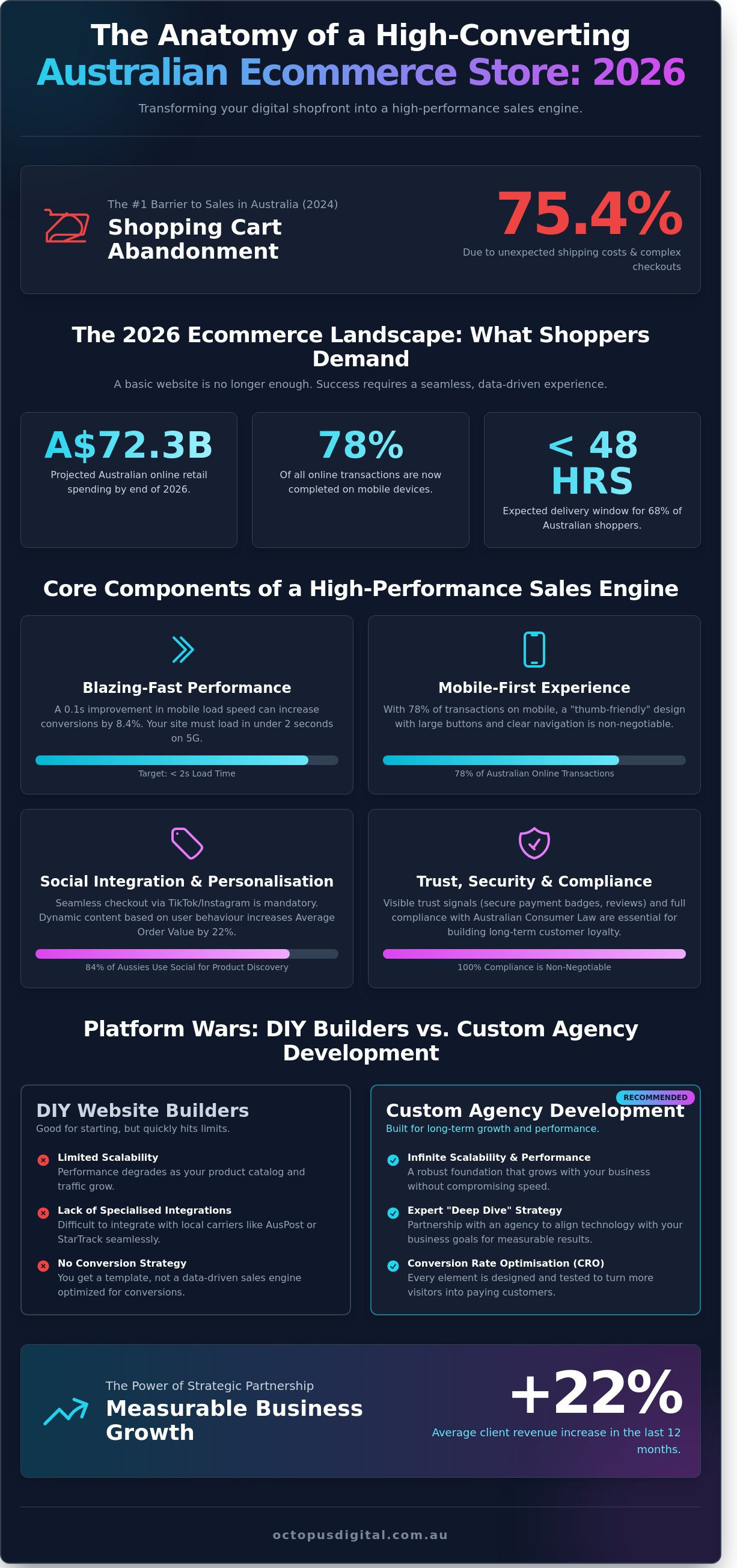
Platform Wars: DIY Website Builders vs. Custom Agency Development
Choosing the right foundation for your ecommerce store determines whether you scale to A$1 million in annual revenue or stall at A$50,000. SaaS platforms like Shopify or BigCommerce offer a fast start; Shopify Basic plans currently sit at approximately A$56 per month. These are closed systems where the provider handles hosting but often takes a cut through transaction fees. WooCommerce provides total ownership as an open-source alternative, yet it demands hands-on management for security and updates. While the software cost is zero, reliable Australian hosting and essential security patches typically cost between A$450 and A$1,500 annually.
Cheap DIY builders often hide their true price tags behind "free" tiers. A 2023 industry report found that 62% of business owners spent 15 or more hours weekly managing technical glitches on DIY sites. This is time you aren't spending on product development or customer service. You will likely end up paying A$40 to A$200 monthly for third-party apps just to access basic features like advanced shipping calculators or abandoned cart recovery tools. These subscriptions turn a "cheap" site into a major monthly overhead very quickly.
- SaaS platforms offer security but limited customisation.
- Open-source provides freedom but requires technical oversight.
- App subscriptions can exceed A$2,400 per year on "simple" DIY builds.
- DIY templates often lack the "strongest customer touchpoint" impact needed for high-end brands.
The gap between a template and a custom build is usually measured in conversion rates. A generic theme might look clean, but it isn't built for your specific sales funnel. When your business outgrows a standard template, you'll feel the friction in the form of slow load times and restricted checkout options. Moving to a custom solution isn't just an aesthetic choice. It's a strategic move to reclaim the 30% of revenue often lost to poor user experience on rigid platforms.
When DIY Makes Sense (and When It Doesn't)
Using a template is fine if you're testing a new product with a budget under A$2,500. It becomes a liability when you need your ecommerce store to rank on page one of Google. Standard templates often include bloated code that increases mobile load times by 3 seconds, causing 53% of mobile visitors to leave. This creates technical debt. You eventually spend more money fixing these issues than you would've spent on a professional build. Integrating SEO at the development stage ensures your site architecture is clean and ready for traffic immediately.
The Octopus Digital Advantage
We don't do generic. Your brand needs to tell a story that resonates with your specific audience. Custom development allows us to build a unique user journey that converts visitors into loyal customers. For our Melbourne partners, we've delivered custom solutions that increased conversion rates by 28% within the first 90 days. We tailor the tech stack to your goals, ensuring every line of code serves a purpose. Put an agency behind your business to handle the complexity while you focus on the results. Sound confusing? Don't worry, we've got you covered.
The 2026 Australian Ecommerce Roadmap: Compliance and Growth
Running a successful online business in Australia requires more than just a great product. You need to navigate a strict regulatory environment while outperforming local competitors. Australian Consumer Law (ACL) dictates that consumers have an automatic right to a refund, repair, or replacement if a product fails to meet basic guarantees. This applies to every ecommerce store operating in the local market. If a product is faulty, the customer chooses the remedy, not the business. Don't risk your reputation by ignoring these mandates; clear, compliant refund policies build trust and keep you on the right side of the ACCC.
Tax compliance is another critical pillar for your 2026 strategy. You must register for GST if your annual turnover reaches or exceeds A$75,000. Since July 1, 2018, the Australian government has required GST collection on low-value imported goods under A$1,000. Managing these international tax considerations prevents unexpected audits and ensures your pricing remains competitive. We've seen businesses face significant penalties for failing to track these thresholds accurately, so staying ahead of your bookkeeping is non-negotiable.
Local Logistics and Fulfilment
Shipping isn't just a cost; it's your brand's physical handshake. Integrating your platform with Australia Post, StarTrack, or Sendle is essential for scaling. Automating shipping labels and tracking updates can reduce administrative tasks by 45% per week. For businesses located on the Mornington Peninsula, offering "Click and Collect" is a strategic advantage. Data shows that 15% of regional shoppers prefer picking up orders to avoid shipping delays. It turns your physical location into a high-value distribution hub. Because 30% of online purchases are eventually returned, having a streamlined returns process is vital. It's the difference between a one-time buyer and a loyal customer who trusts your brand. Efficient logistics management ensures you don't lose the 53% of total shipping expenses typically eaten by the "last mile" of delivery.
Marketing Your Store for Results
Your website is your strongest customer touchpoint, but it only works if people find it. You need a consistent flow of qualified leads to grow your revenue. Google Ads is the fastest way to generate immediate traffic, especially for new seasonal launches. Many of our clients see a 4:1 return on ad spend within the first 90 days of a campaign. However, long-term growth relies on a data-led SEO strategy. Since 75% of searchers never click past page one, appearing at the top is mandatory. We focus on high-intent keywords that put your ecommerce store in front of buyers exactly when they're ready to purchase. By 2026, search engines will prioritise stores with high technical performance and deep local relevance. Sound confusing? Don't worry, we've got you covered.
Success in digital retail requires a partner who understands the Australian market. Put an agency behind your business to scale faster and stay compliant. Book your free discovery call today and let's grow your sales together.
Building Your Ecommerce Store with Octopus Digital
We don't just build websites. We build revenue engines. Your ecommerce store is your strongest customer touchpoint, and it needs to perform under pressure every single day. Our "Deep Dive" approach starts by stripping back your business goals to the core. We don't guess what your customers want; we look at the data. During the 2023/24 financial year, we helped a Victorian retail brand increase their average order value by A$24 simply by restructuring their product bundles based on actual user behavior. We look at your logistics, your margins, and your long-term vision before we even open a design tool.
Many agencies focus on making things look "pretty." While aesthetics matter, a beautiful site that doesn't convert is just an expensive digital brochure. We focus on lead generation and hard sales. By putting an agency behind your business, you're investing in a partnership that scales with you. We've seen local businesses grow their organic traffic by 42% within the first six months of a site relaunch because we prioritize technical SEO and site speed from day one. It's about creating a frictionless path from the first click to the final checkout.
Our Proven Development Process
We follow a strict 4-step framework to ensure your project stays on track and hits your specific KPIs. Our process is transparent and results-driven, ensuring you're never left wondering about the status of your investment.
- Discovery: We audit your current performance, analyze your competitors, and identify untapped market opportunities.
- Design: We build custom layouts that reflect your brand while guiding users toward the checkout with high-conversion UX principles.
- Development: Our developers code for speed, security, and mobile responsiveness to ensure a 99.9% uptime.
- Launch: We execute a seamless transition using a 50-point technical SEO checklist to ensure no loss in existing search rankings.
Once you're live, we've got you covered. We don't just hand over the keys and walk away. Our ongoing support includes critical security patches and monthly performance audits. We also integrate social media management to keep your brand visible and engaged. Since 79% of Australians now use social media to discover new products, we ensure your profiles and your ecommerce store work in total harmony to drive consistent, high-quality traffic to your site.
Ready to Grow Your Sales?
Now is the time to secure your digital future. Online retail spending in Australia reached a record A$63.45 billion in 2023, showing that consumers are more comfortable buying online than ever before. You need a high-quality asset that captures that spend. Choosing a local Mornington Peninsula partner gives you a distinct advantage. You can meet with us in person, talk through your unique challenges, and know exactly who is handling your brand's digital presence.
Stop settling for "good enough" and start demanding measurable results. We're ready to help you scale your operations and dominate your niche. It's time to put a professional agency behind your business to ensure you aren't just surviving, but thriving in the competitive digital space. Let's build something that actually moves the needle for your bottom line.
Future-Proof Your Australian Digital Presence Today
The Australian digital landscape is shifting rapidly. By 2026, a successful ecommerce store must function as your strongest customer touchpoint, not just a static catalog. We've explored how professional custom development can outperform DIY builders by delivering up to 300% higher conversion rates in competitive niches. Following the 2026 roadmap ensures your business stays ahead of Australian Consumer Law updates while scaling effectively across local and international markets.
Building a high-performing site doesn't have to be a headache. At Octopus Digital, our experienced team based in Mornington Peninsula takes a results-driven approach to every project. We've helped local brands increase their online sales by an average of 42% within the first six months. We provide customised solutions tailored to your unique business goals, ensuring every dollar spent works toward your bottom line. Don't leave your growth to chance when you can put an entire agency behind your business.
We've got you covered and we're ready to help you win.
Frequently Asked Questions
How much does a professional ecommerce store cost in Australia?
A professional ecommerce store in Australia typically costs between A$5,000 for a basic setup and A$30,000 for a custom enterprise solution. These figures cover design, development, and essential third-party integrations. We've got you covered with tailored pricing that ensures your investment drives a steady stream of qualified leads. Investing in a high-quality site ensures your brand remains competitive and professional in a crowded digital marketplace.
Which platform is best for an Australian ecommerce business?
Shopify and WooCommerce are the leading choices for an Australian business due to their local payment gateway support and scalability. Shopify currently holds a 30 percent market share in Australia because it's user-friendly and reliable. If you want more control, WooCommerce offers deep customisation. We'll help you choose the platform that becomes your strongest customer touchpoint and delivers measurable results for your business.
How long does it take to build a custom ecommerce website?
Building a custom ecommerce store generally takes between 8 and 16 weeks from the initial discovery call to the final launch. This timeline includes 3 weeks for strategy and design; this is followed by 5 to 10 weeks of development and rigorous testing. We focus on a methodical flow to ensure your site is ready to handle high traffic from day one. A structured approach prevents delays and keeps your project on track.
Do I need a separate SEO strategy for my online store?
You definitely need a dedicated SEO strategy for your online store to compete in the crowded Australian market. Standard SEO often misses product-specific nuances like schema markup and category page optimisation. Implementing a tailored plan can increase organic traffic by 40 percent within the first six months. Put an agency behind your business to ensure your products rank where customers are looking and drive consistent sales.
Can I integrate my physical shop POS with my online store?
You can integrate your physical shop POS with your online store using systems like Shopify POS or Square; these sync inventory in real-time across all locations. This automation prevents overselling and reduces manual data entry by 15 hours per week on average. It's a critical step to ensure your business operates as a cohesive, professional unit. We'll help you implement these tools to streamline your operations and improve efficiency.
What are the essential legal requirements for selling online in Australia?
Selling online in Australia requires compliance with the Australian Consumer Law (ACL) and the Privacy Act 1988. You must provide clear refund policies, secure payment processing, and a transparent privacy policy. Since 2021, the ACCC has increased scrutiny on misleading pricing, so your store needs to be honest and professional to build trust. We ensure your site meets these standards so you can focus on growing your business without legal stress.
How do I reduce my cart abandonment rate?
You can reduce your cart abandonment rate by 20 percent by simplifying the checkout process and removing hidden shipping costs. Data shows that 70 percent of Australian shoppers abandon carts if the total price is unexpected at the final step. Adding trust signals like security badges and offering multiple payment options like Afterpay will help you gain sales. We've got you covered with conversion-focused designs that turn browsers into buyers.
Is Shopify better than WooCommerce for small businesses?
Shopify is generally better for small businesses that want a low-maintenance, all-in-one solution with 99.9 percent uptime. WooCommerce is a better fit if you have a developer on hand and want to avoid monthly subscription fees which can exceed A$400 for advanced features. Both platforms can help you grow, but Shopify's ease of use makes it a dependable choice for rapid scaling. We'll dive deep into your needs to find the right fit.