How Much Does a Website Cost in Australia 2026? The Complete Pricing Guide
Why does one Australian web design agency quote you A$5,000 for a new website, while another quotes A$25,000 for the exact same project brief? If you've started looking for a quote, you know this frustration is real. You’re ready to invest in your strongest customer touchpoint to drive sales, but the wildly different numbers and vague proposals make it impossible to plan for genuine business growth.
It’s a confusing landscape. You're right to be cautious about hidden costs, and it's perfectly valid to wonder if powerful AI tools should be making everything cheaper. This guide cuts through the noise. We're providing a transparent, results-focused answer to the critical question: how much does a website cost in Australia 2026? You'll get a complete pricing framework, from high-converting landing pages to powerful e-commerce engines built to generate a steady stream of qualified leads.
We’ll break down the true ROI of custom design versus templates, expose the ongoing fees you must budget for, and give you the confidence to choose a local partner that delivers measurable results. Don't worry, we've got you covered.
Key Takeaways
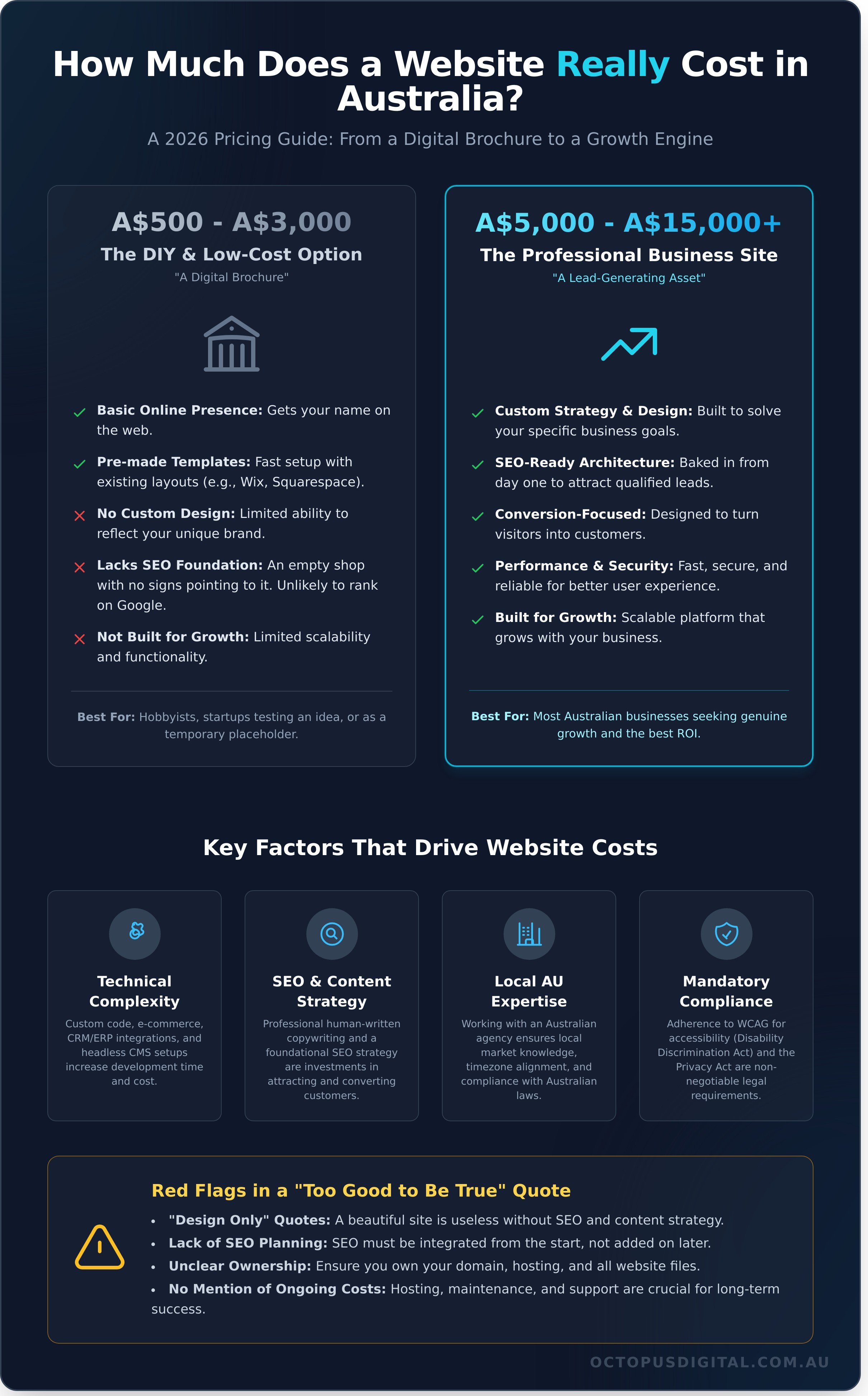
- Understand the critical difference between a basic A$3,000 website and a A$15,000+ lead-generating asset to ensure you invest in real business growth.
- Get a clear answer to how much does a website cost in Australia 2026 by exploring the key factors that drive quotes up or down, from local expertise to custom functionality.
- Discover the crucial ongoing costs beyond the initial build, including secure hosting and growth-focused maintenance, to accurately budget for long-term success.
- Learn to spot the red flags in a low-cost website quote, such as a lack of SEO planning or unclear ownership, to avoid expensive rebuilds down the track.
Factors Influencing Website Costs in the 2026 Australian Market
Asking "how much does a website cost in australia 2026" is like asking how much a vehicle costs. A simple ute and a prime mover both have four wheels and an engine, but their purpose, complexity, and price are worlds apart. By 2026, a website is no longer a digital business card; it's your hardest-working sales tool, a primary customer service channel, and a powerful data-gathering asset. Understanding the key factors that determine its price is the first step to investing in a platform that delivers real business growth, not just an online presence.
The "Australian Standard" also plays a significant role. Working with a local Australian agency commands a premium for good reason. It ensures your project is managed by a team that understands the local market, consumer psychology, and is available in your timezone. More importantly, it guarantees compliance with Australian laws, from consumer rights to data privacy regulations.
AI-assisted development has shifted the goalposts. While AI tools can accelerate initial code generation by up to 30%, they haven’t made expert developers obsolete. Instead, the value has shifted to strategic oversight, complex integrations, and quality assurance. The cost saving on basic code is now reinvested into ensuring the AI-generated components are secure, efficient, and perfectly aligned with your business goals.
Furthermore, mandatory compliance is now a non-negotiable part of the base cost. Since the Disability Discrimination Act 1992 was confirmed to apply to websites, building to Web Content Accessibility Guidelines (WCAG) is essential. Similarly, adhering to the Privacy Act 1988 is a foundational requirement, not an optional extra. These legal necessities protect your business and are built into any professional quote from day one.
Technical Complexity and Customisation
The core of your website's cost lies in its technical foundation. A simple template-based WordPress site will always be cheaper upfront than a custom-coded headless site using frameworks like Next.js, but the latter delivers superior speed, security, and scalability. The real cost emerges with integrations. Connecting your site to a CRM like Salesforce, an ERP system, or other third-party APIs requires expert development. For those new to the terminology, Wikipedia offers a great primer on what is web development? and its core concepts. Taking shortcuts here creates technical debt, which is the implied cost of rework caused by choosing an easy, limited solution now instead of using a better approach that would take longer.
The Role of Content and SEO in Initial Pricing
A "design only" quote is a trap for any serious business in 2026. A beautiful website with no strategic content or technical SEO is an empty digital shop with no signs pointing to it. The cost of professional, human-written copywriting is an investment in converting visitors into customers, while relying on basic AI-generated placeholders often results in generic content that fails to rank on Google. Effective SEO services are not an add-on; they must be baked into the website's architecture, content strategy, and code from the very beginning to drive qualified leads and deliver a measurable return on investment.
A Breakdown of Website Pricing Tiers: From DIY to Custom Enterprise
Understanding what you're paying for is the first step to making a smart investment. Website costs in Australia are not arbitrary; they directly reflect the level of expertise, customisation, and business results you can expect. The price tag is tied to the value it will generate for your business, from a simple online brochure to your strongest customer touchpoint.
Let's break down the common pricing tiers you'll encounter when exploring how much does a website cost in australia 2026 .
- The A$500 - A$3,000 Tier: DIY & Ultra-Low-Cost. This bracket typically covers DIY platforms like Wix or Squarespace, or hiring a junior freelancer. While the upfront cost is low, you're often paying with your own time. These sites use pre-made templates, offer limited customisation, and rarely include the strategic SEO foundation needed to attract customers. They can be a starting point, but they aren't built to be a primary driver of business growth.
- The A$5,000 - A$15,000 Tier: Professional Small Business Sites. This is where most Australian businesses find the best return on investment. This price point moves you from a basic template to a custom-designed, performance-focused website built to convert visitors into leads and sales. It's an investment in a strategic asset, not just an online expense.
- The A$20,000 - A$50,000+ Tier: High-Performance & Enterprise. For businesses requiring advanced functionality, this tier is essential. This includes large-scale e-commerce stores with thousands of products, custom web applications, or corporate sites with complex integrations like CRM or inventory management systems.
The Small Business Sweet Spot (A$5k - A$12k)
For a service-based business, this investment delivers a powerful, lead-generating machine. A typical project in this range includes custom UI/UX design tailored to your brand, full mobile optimisation, and foundational SEO to get you ranking on Google. For a tradesperson on the Mornington Peninsula, this means a site built to capture local search traffic and drive quote requests. For a professional services firm in Melbourne, it's a site that builds credibility and funnels enquiries. In 2026, a realistic timeline from our initial discovery call to launch is 6-10 weeks.
E-commerce and Complex Functionality (A$15k+)
Selling products online introduces another layer of complexity. The platform choice is critical; Shopify is excellent for rapid deployment, while a custom WooCommerce build offers unmatched flexibility for unique business rules. For a deeper look into the platform's journey, the story shared by Shopify experts NB eCommerce & Design is quite insightful. The investment here covers more than just design. It includes secure payment gateway integration (like Stripe or eWay), logic for Australian shipping carriers, and inventory management. This pricing aligns with the need for a robust, secure, and scalable online store. For a full breakdown of these platforms, see our comprehensive Ecommerce Website Development guide.
Consider a niche online store like Peptide Research AU, which sells specialized laboratory compounds. For such a business, the website is not just a storefront; it's a critical tool for establishing credibility and trust. The build must handle secure transactions, detailed product information, and adhere to industry standards, placing it firmly in this advanced e-commerce investment tier.
Ultimately, choosing the right tier means aligning your budget with your business goals. Investing in the A$5k - A$15k "middle ground" provides the strategic foundation most businesses need to grow, a fact supported by industry analysis like the Forbes 2026 pricing guide, which shows professional design directly impacts customer trust and conversion rates. It’s about building an asset that works for you 24/7. Understanding where your business fits is the first step, and we can help you define a web strategy that drives real results.
Beyond the Build: Understanding Ongoing Costs and ROI
Securing a quote for a new website is just the first step. The initial build is only one part of the puzzle when determining how much a website costs. To truly understand your investment, you must look beyond the launch date. A high-performance website isn't a one-off purchase; it's your strongest customer touchpoint and a dynamic business asset that requires ongoing attention to deliver a powerful return.
Many businesses get caught out by hidden or unplanned expenses. Let's break down the essential ongoing costs that separate a stagnant digital brochure from a lead-generating machine. These are the investments that ensure your website grows with your business and continues to produce results long after launch.
Thinking about how much does a website cost in Australia 2026 requires a shift in perspective. Instead of viewing it as a cost centre, see it as an investment in your primary sales tool. Here's what you need to budget for:
- Hosting: That tempting A$10/month hosting plan is a significant risk to your 2026 SEO strategy. Cheap, shared hosting often means slow load speeds and poor security. With Google's Core Web Vitals now a critical ranking factor, a 2-second page load delay can kill your search visibility and increase your bounce rate by over 30%. Premium Australian hosting ensures speed, security, and reliability.
- Maintenance vs. Growth: There's a vital difference between "maintenance" and "growth." Maintenance is about keeping the lights on: fixing bugs, updating plugins, and running security scans. Growth is about actively optimising for conversions: A/B testing headlines, improving user pathways, and adding new features to capture more leads. One protects your asset; the other multiplies its value.
- Security and Compliance: In Australia, compliance with the Privacy Act isn't optional. Regular security updates and monitoring are essential to protect your customers' data and your brand's reputation. A single data breach can lead to significant fines and an irreversible loss of trust.
The Reality of Maintenance Packages
A professional maintenance package, typically starting around A$250/month, is your website's insurance policy. It should include daily backups, software and plugin updates, and security monitoring. Crucially, it must also feature Performance Monitoring. Tracking metrics like Lighthouse scores and Core Web Vitals ensures your site remains fast and user-friendly, protecting your hard-won SEO rankings. Having local Australian support means you get expert help in your time zone, which is critical for business continuity.
Marketing and Lead Generation Budgets
A beautiful website without traffic is like a billboard in the desert. It exists, but no one sees it. To generate leads and sales, you must actively drive qualified traffic. Budgeting for a strategic Google Ads campaign alongside your new build is non-negotiable. There's a powerful synergy here: a high-quality, fast-loading website improves your Google Quality Score, which directly lowers your advertising Cost Per Click (CPC). This means your marketing dollar goes further, delivering a better ROI.
So, how does this justify a A$10,000+ spend? It reframes the entire question. Instead of asking how much does a website cost in Australia 2026 , you start asking "what is the monthly return on my digital asset?". Imagine your site gets 4,000 visitors a month and converts 1% into leads (40 leads). A professionally designed and optimised site could lift that conversion rate to just 2%. You now have 80 leads. If each lead is worth A$250 to your business, you've just generated an extra A$10,000 in potential revenue. Every single month.
Avoiding the "Cheap Website" Trap: What to Look for in a Quote
A rock-bottom price tag looks tempting. We get it. But a cheap website quote is often a red flag for what’s not included. These omissions can cost you thousands in lost sales, redevelopment costs, and missed opportunities down the line. A cheap quote often masks the true answer to 'how much does a website cost in australia 2026' by omitting these critical, long-term success factors.
Before you sign, scrutinise any low-cost proposal for these common traps:
- No SEO Foundation: A website without technical SEO is like a billboard in the desert. It might look great, but no one will ever find it. This includes basics like sitemaps, schema markup, and optimised page titles that are essential for ranking on Google from day one.
- No Mobile Testing: In 2023, the Australian Communications and Media Authority (ACMA) reported that 93% of Australian adults own a smartphone. If your site isn’t rigorously tested and optimised for mobile, you’re actively turning away the vast majority of your potential customers.
- The "Offshore Management" Hidden Cost: While seemingly cheaper, managing an offshore team from Australia introduces significant friction. A 5-hour time difference with a team in India (IST) means your "urgent" morning fix won't even be seen until their day begins, delaying your business operations. Communication gaps can lead to costly rework and a final product that doesn't understand the local market.
- Vague Ownership and IP: Who actually owns your website? A cheap quote might mean the developer retains ownership of the code, effectively holding you hostage. You must have it in writing that you own your domain name and receive full, unrestricted access to the website’s source code upon final payment.
Professional agencies avoid these pitfalls by insisting on a "Discovery Phase." This paid strategic process maps out your business goals, target audience, and technical requirements before a single line of code is written. It prevents scope creep, aligns the project with your commercial objectives, and ensures the final quote is a realistic investment, not a hopeful guess.
Questions to Ask Your Potential Web Agency
Arm yourself with direct questions that reveal an agency's quality and process. A professional partner will have confident, detailed answers.
- "Will this site be accessible (WCAG 2.2 compliant)?" This isn't just about ethics; it's about compliance with Australia's Disability Discrimination Act 1992. It also expands your potential market by up to 18%.
- "Do you provide a custom reporting dashboard for KPIs?" You need to measure what matters. A dashboard tracking leads, conversion rates, and traffic sources proves your website is generating a tangible return on investment.
- "Is the site built for speed (Google Lighthouse 90+ scores)?" According to Google, the probability of a user bouncing increases by 32% as page load time goes from one to three seconds. A high Lighthouse score is a non-negotiable for user experience and SEO.
The Importance of Local Knowledge
An agency on the Mornington Peninsula or in Melbourne's CBD understands the local competitive landscape in a way an offshore or interstate firm simply can't. They know who you're up against and what your customers expect. For high-ticket builds, face-to-face discovery sessions are invaluable for building a deep, strategic partnership. Local consumer trends directly dictate effective UI/UX choices; for instance, a Melbourne-based retailer’s checkout process must cater to a mobile-first audience accustomed to specific payment gateways like Afterpay and Zip Pay. Understanding these nuances is key to accurately forecasting how much does a website cost in australia 2026 for a business that plans to grow.
Our comprehensive Discovery Phase is designed to uncover these critical details and provide a quote that guarantees results. Book your free discovery call to build a website that delivers real business growth.
Choosing Octopus Digital: Investing in Your Strongest Customer Touchpoint
You've explored the different types of websites and the factors that influence their price. But the most critical question isn't just about cost; it's about return. A website is more than a digital business card. It's your hardest-working employee, your 24/7 salesperson, and your single strongest customer touchpoint. At Octopus Digital, our entire philosophy is built on this principle. We don't just build websites; we build strategic assets designed to drive real, measurable growth for your business.
Our results-driven approach means every design choice, line of code, and content strategy is directly linked to a business outcome. We dive deep into your operations, your customers, and your goals to create a digital experience that actively generates leads and sales. We move the conversation from "how much will this cost?" to "what revenue will this generate?" This perspective transforms your website from a necessary expense into a powerful investment in your future success.
Put an Agency Behind Your Business
Why juggle a freelance designer, a separate developer, and an SEO consultant when you can have a cohesive, experienced team in your corner from day one? When you partner with us, you get the combined expertise of our entire agency: strategists, designers, SEO specialists, and Google Ads experts all working together. We have a proven track record of delivering high-quality, high-performing websites for Australian businesses, from local service providers to national e-commerce brands. We handle all the complexity, so you don't have to. Sound confusing? Don't worry, we've got you covered.
Tailored Solutions for Local Success
A generic online calculator can't accurately answer how much does a website cost in australia 2026 for a business with specific growth targets. Your quote from Octopus Digital is never off-the-shelf. It's a customised proposal built around your unique objectives, target audience, and competitive landscape. We create a strategic plan, not just a list of features, ensuring every dollar you invest is aimed at achieving your goals. For a look at how we apply this approach on a local level, see our Web Design Mornington guide, which features case studies of businesses we've helped thrive.
Are you ready to stop guessing and start planning for growth? Let's define what success looks like for you in 2026 and build the digital asset that will get you there.
Take the next step. Book a no-obligation chat with our team to discuss your vision and receive a detailed, tailored quote.
Build Your Strongest Asset for 2026 and Beyond
Navigating the question of how much does a website cost in australia 2026 reveals a crucial business truth: your investment should be measured by its return, not just the initial price tag. As we've covered, the true cost is influenced by custom functionality, long-term goals, and the expertise of your digital partner. A cheap website often becomes the most expensive mistake, costing you sales and credibility down the line.
Your website is your strongest customer touchpoint; it's where growth begins. At Octopus Digital, our experienced, Mornington Peninsula based team doesn't just build websites; we engineer high-converting digital assets. We leverage proven, results-driven digital marketing strategies to ensure your new site becomes a powerful engine for generating leads and increasing your sales.
Ready to get a clear, transparent quote and a strategy tailored to your specific business goals? Book Your Free Discovery Call with Octopus Digital today and let's build a website that delivers measurable results.
Frequently Asked Questions About Website Costs in Australia
Is a $2,000 website enough for a small business in Australia in 2026?
A A$2,000 website is a starting point, but it's rarely enough for a small business focused on growth. This budget typically gets you a basic template site with minimal customisation and no marketing integration. It won't include professional copywriting or the foundational SEO needed to attract customers. Think of it as a simple digital brochure, not a high-performance tool designed to generate leads and sales for your business.
How much does a basic 5-page business website cost?
When asking how much does a website cost in Australia 2026 , a professional 5-page site is a common benchmark. Expect to invest between A$3,500 and A$7,000 for a high-quality result. This price typically covers a custom design, mobile responsiveness, and essential pages like Home, About, Services, and Contact. This assumes you supply the written content and images; professional copywriting and photography are additional investments.
What are the ongoing monthly costs for a professional website?
Ongoing monthly costs to maintain a professional website generally range from A$50 to A$250. This covers the essentials needed to keep your site secure and online. Core costs include quality web hosting (A$30-A$60/month), your domain name renewal (approx. A$25/year), and a website care plan for software updates, security scans, and backups (A$80-A$200/month). This doesn't include active marketing services like SEO or Google Ads management.
Why are Australian web design agencies more expensive than offshore options?
Australian web design agencies command higher prices due to local labour costs, a deep understanding of the Australian market, and accountability under Australian Consumer Law. You're investing in clear communication within your own time zone and a team that builds websites strategically for Australian customers. This local expertise results in a more effective digital asset that drives real business growth, providing a far greater return on investment over time.
How much extra does e-commerce functionality add to a website cost?
Adding e-commerce functionality to a website typically increases the cost by A$4,000 to A$15,000 or more. The final price depends on the complexity of your online store. A simple shop with under 50 products and standard payment gateways like Stripe will be at the lower end. A large-scale store with thousands of products, complex shipping rules, and integrations with systems like Afterpay will require a more significant investment.
Does the cost of a website include SEO and content writing?
No, a standard website build quote doesn't include a full SEO campaign or professional content writing. The initial cost usually covers technical, on-page SEO foundations like correct page titles and mobile-friendliness. However, strategic keyword research, link building, and creating conversion-focused content are specialised services. These are essential for driving traffic and are quoted separately as either a one-off project or an ongoing monthly retainer.
How long does it take to build a custom website in 2026?
A custom small business website in Australia typically takes between 6 and 12 weeks from our initial strategy session to launch. This timeline is broken into key phases: discovery and planning (1-2 weeks), custom design (2-3 weeks), development and coding (3-5 weeks), and finally content loading and client revisions (1-2 weeks). The project's final timeline is also dependent on receiving timely feedback and content from you, the client.
Can I use AI to build my business website for free?
While you can use AI builders to generate a basic site for free, it's not a viable solution for a business that needs to generate leads and sales. These tools often produce generic designs and uninspired content that fails to connect with your target audience. A professionally built website is a strategic business asset, crafted by an experienced team to achieve specific goals. An agency partnership ensures your website is a powerful tool for growth, not just a digital placeholder.