How to Create My Own Online Store: The 2026 Australian Business Guide
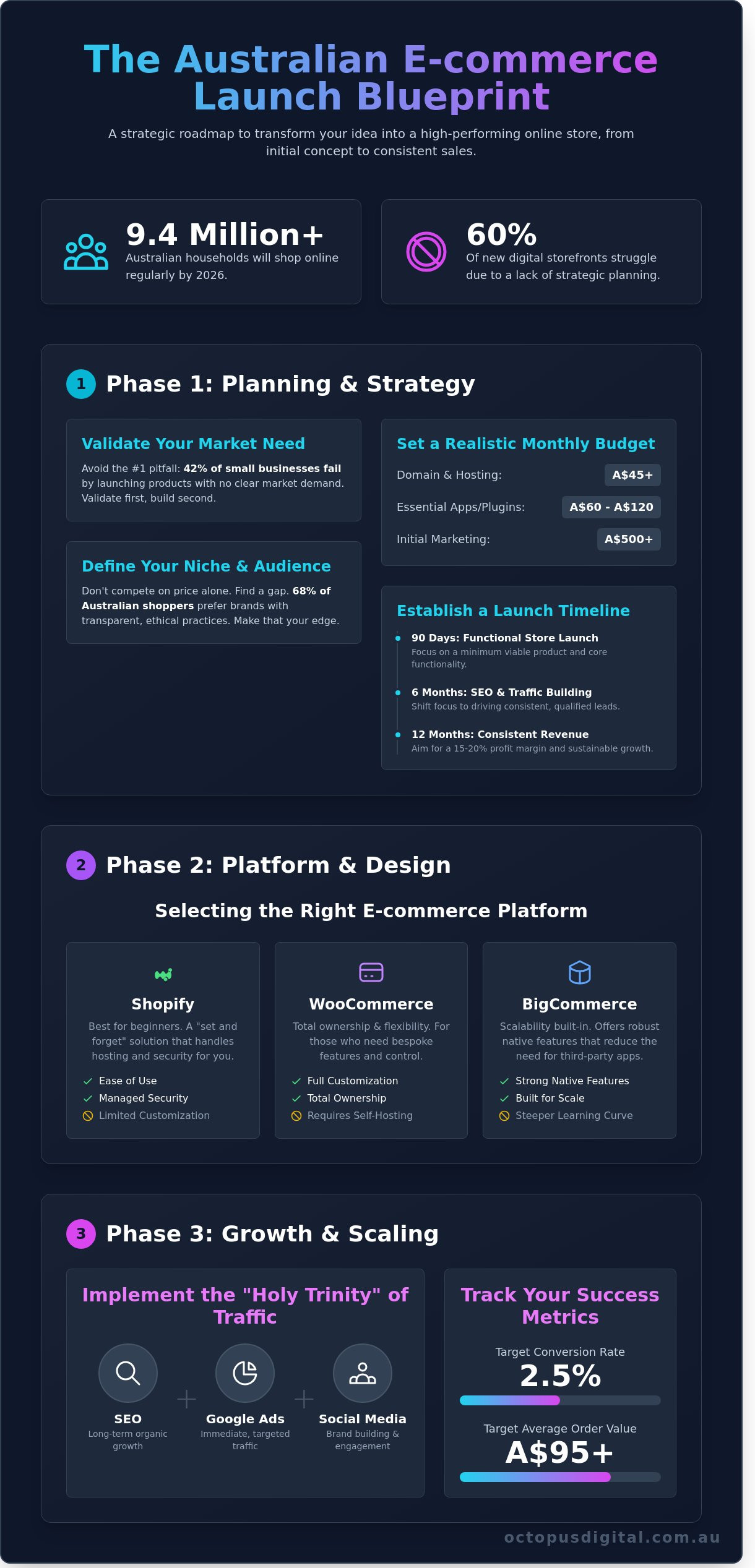
By 2026, over 9.4 million Australian households will shop online regularly, yet 60% of new digital storefronts struggle to gain traction because owners search for how to create my own online store without a clear strategic plan. You're likely feeling the weight of analysis paralysis, stuck between dozens of platform options and the fear of hidden costs that could blow your budget. It's common to worry about Australian-specific compliance like GST or privacy laws when you just want to focus on your products. We believe your website should be your strongest customer touchpoint, not just a digital business card that sits idle.
This guide simplifies the journey by providing a strategic roadmap that balances professional design with local regulations. You'll learn the exact steps to launch a high-converting shop that builds immediate trust and drives real revenue. We've got you covered with a clear breakdown of the real A$ costs involved and a proven plan to secure your first customer without the usual guesswork. This is your complete path from initial concept to a profit-generating business in the competitive Australian market.
Key Takeaways
- Transform your website from a simple digital business card into your brand's strongest customer touchpoint and a high-performing sales engine.
- Learn how to select the right e-commerce platform-like Shopify or WooCommerce-to perfectly match your technical comfort level and long-term growth goals.
- Follow a professional roadmap on how to create my own online store with essential Australian configurations, including .com.au domain setup and GST compliance.
- Master high-conversion design principles like the "3-Second Rule" to build immediate trust and bridge the physical gap with your digital customers.
- Scale your business results by implementing the "Holy Trinity" of traffic-SEO, Google Ads, and Social Media-to ensure your new store drives consistent sales.
Planning Your Digital Shopfront: More Than Just a Website
In 2026, your website is your strongest customer touchpoint. It's no longer a static digital business card that simply sits online. It's a high-performance sales engine designed to grow your business 24/7. To build a successful brand, you must first understand what is e-commerce in the modern Australian context. It's an integrated ecosystem where every click must lead to a measurable result. If you're researching how to create my own online store, you need to move past aesthetics and focus on a strategy that drives high-quality leads and sales.
Validation is your first critical hurdle. Data from 2024 indicates that 42% of small businesses fail because they launch products without a clear market need. You must validate your product-market fit before spending a single cent on development. Once you've confirmed demand, set concrete goals to track your progress. A successful Australian e-commerce site should aim for a 2.5% conversion rate and an average order value (AOV) of at least A$95 to offset rising logistics costs. We've got you covered with the roadmap below to ensure your planning phase translates into actual revenue.
Defining Your Niche and Audience in a Crowded Market
Success requires a deep dive into competitor gaps. Don't try to compete with retail giants on price alone. Instead, find a specific angle that they overlook. If competitors in the Australian homewares space neglect sustainable packaging, make that your core Value Proposition. Australian consumers are discerning; 68% of shoppers in 2025 reported they prefer brands with transparent ethical practices. Define your primary persona by their specific pain points. Are they a time-poor professional in Brisbane looking for quick solutions, or a hobbyist in Perth seeking premium materials? Tailoring your site to these specific needs is how you gain sales by driving the right online traffic to your business.
Setting Realistic Budgets and Timelines for 2026
A professional store requires a structured financial plan. While "free" tools exist, they often cost more in the long run through lost sales and poor search engine visibility. You need to put an agency mindset behind your business from the start. Budget for these essential Australian costs:
- Domain and Hosting: Expect to pay A$20 to A$40 for a .com.au domain and A$45+ monthly for a secure platform.
- Apps and Integration: Essential tools for email marketing and SEO usually add A$60 to A$120 to your monthly overheads.
- Marketing: Allocate at least A$500 per month for initial lead generation to build momentum.
Your timeline should be just as structured. Aim to launch a functional version of your store within 90 days. By the 6-month mark, your focus should shift to Search Engine Optimisation (SEO) to drive a steady stream of qualified leads. By 12 months, your goal is a consistent monthly revenue that sustains a 15% to 20% profit margin. Understanding how to create my own online store is about more than just clicking "publish"; it's about building a dependable sales engine that delivers long-term growth.
Selecting the Right E-commerce Platform for Your Goals
Choosing the engine for your digital storefront determines your daily workload and your eventual profit margins. In the Australian market, three names dominate the conversation: Shopify, WooCommerce, and BigCommerce. Shopify currently powers over 100,000 Australian businesses because it's a closed ecosystem that handles security and hosting for you. WooCommerce offers total ownership but requires you to manage your own WordPress hosting. BigCommerce sits in the middle, offering robust native features that reduce the need for expensive third-party apps as you scale.
If you're wondering how to create my own online store without hiring a full-time developer, Shopify is the most logical starting point. It's a "set and forget" solution that lets you focus on sales rather than server maintenance. However, if your business model requires a bespoke checkout experience or complex product builders, WooCommerce provides the flexibility you need. Matching the platform to your technical comfort level prevents the common "founder burnout" that happens when technical hurdles stall marketing efforts.
Scalability is the most critical factor for long-term success. A platform that works for ten orders a day might crumble or become prohibitively expensive at 500 orders a day. You must look at the Total Cost of Ownership (TCO) beyond the base monthly fee. For example, a Shopify Basic plan starts around A$45 per month, but transaction fees and app subscriptions for loyalty programs or advanced shipping can easily push your monthly overhead to A$200 or more. WooCommerce has no monthly "rent," but you'll pay for premium hosting, security certificates, and annual plugin renewals.
SaaS vs. Open Source: Which Path Should You Take?
Shopify represents the SaaS (Software as a Service) model. It's built for rapid deployment. You can have a functional store live in under 48 hours. For Australian small businesses, this model is often safer because the platform manages PCI compliance and security patches automatically. WooCommerce is Open Source, giving you 100% control over your data. While this avoids platform "lock-in," it means you're responsible for every update. If a plugin breaks, your checkout might go down, costing you sales until it's fixed.
Why Your Choice Impacts SEO and Long-Term Growth
Your platform's underlying architecture directly dictates your Google ranking. Site speed is a confirmed ranking factor; a store that loads in under 2 seconds has a 15% higher conversion rate than one taking 4 seconds. Shopify's global Content Delivery Network (CDN) ensures fast load times across Australia. Conversely, WooCommerce allows for deeper technical SEO customisation, but poor hosting or "bloated" templates can lead to slow performance and "clean code" issues that frustrate search engines.
Integrating your store with professional SEO services from the very beginning ensures your site architecture is built to attract traffic, not just look pretty. Before you commit to a niche, it's wise to research online business ideas for Australians to ensure your chosen market has enough search volume to sustain growth. When you're figuring out how to create my own online store, remember that a beautiful site is useless if it's invisible to your customers. We've got you covered by helping you select a platform that balances ease of use with the technical requirements of modern search engines.
Success in e-commerce isn't just about the launch. It's about building a foundation that supports 300% year-on-year growth without requiring a total rebuild. Put an agency behind your business to ensure your platform choice aligns with your five-year goals, not just your first month of sales.
Designing for Sales: The Anatomy of a High-Converting Store
Your website is your strongest customer touchpoint. When you're researching how to create my own online store, you'll find that design is about much more than just looking good. It's a fundamental trust signal. The 3-Second Rule is a reality in the Australian e-commerce landscape. Visitors decide whether to trust your brand or bounce within three seconds of the page loading. Professional, clean layouts suggest a professional, reliable business. If your site looks cluttered or outdated, customers will assume your service matches that standard.
High-quality imagery and video are essential to bridge the physical gap between the screen and the customer. Since shoppers can't touch or feel your products, you must provide 4K zoom-enabled photos and 360-degree product videos. This level of detail reduces perceived risk. Don't stop at visuals; the psychology of your "Add to Cart" button matters too. Use high-contrast colours that pop against your background. A bright orange or green button on a white background creates a clear path to purchase. If the checkout flow feels long, you'll lose people. Keep the process linear and transparent.
Social proof serves as the ultimate "nudge" for hesitant buyers. Feature reviews, testimonials, and case studies prominently on your product pages. Statistics show that 95% of shoppers read online reviews before making a purchase. Seeing a "Verified Buyer" badge from a fellow Australian builds immediate credibility. It proves that your store delivers on its promises. We've got you covered when it comes to integrating these trust elements effectively to drive results.
User Experience (UX) Secrets That Drive Conversions
Navigation must be intuitive and fast. We recommend the 3-click rule: a customer should be able to find any specific product within three clicks from your homepage. If your catalogue is large, an optimised site search is a non-negotiable feature. Intent-driven shoppers who use search bars are nearly twice as likely to convert as those who just browse. You can also reduce cart abandonment by following these steps:
- Offer Guest Checkout: Forcing users to create an account causes 24% of cart abandonments.
- Display All Costs Early: Unexpected shipping fees at the final step are the leading cause of lost sales.
- Show Progress Bars: Let customers know exactly how many steps are left in the checkout process.
Mobile-First Design: The Non-Negotiable Standard
Mobile commerce isn't just a trend; it's the primary way Australians shop. The Australia Post 2024 E-commerce Industry Report confirms that over 73% of Australian online purchases now happen on mobile devices. If your store isn't built for a small screen first, you're ignoring the majority of your market. This means ensuring all interactions are "thumb-friendly." Buttons should be large enough to tap easily, and menus must be simple to navigate with one hand.
Speed is just as critical as layout. Mobile users expect pages to load in under 2.5 seconds. Any longer and your bounce rate will skyrocket. Always test your store across various devices, including different iPhone and Android models, to ensure the experience is seamless. Put an agency behind your business to ensure your technical performance matches your brand's ambitions. A fast, mobile-responsive store is the foundation of long-term business growth.
The Step-by-Step Launch Checklist for Australian Businesses
Launching your digital storefront is a major milestone, but the final 10% of preparation often determines your long-term success. You've built the structure; now you must ensure it functions perfectly within the Australian regulatory landscape. Start by securing your .com.au domain. You need a valid Australian Business Number (ABN) to register this, which immediately signals to local shoppers that you're a legitimate domestic entity. Pair this with a professional email address to ensure every customer touchpoint looks high-quality and authoritative.
Tax compliance is your next priority. In Australia, the standard Goods and Services Tax (GST) is 10%. If your business turnover reaches or exceeds the A$75,000 threshold, you must register for GST and include it in your pricing. Most modern e-commerce platforms allow you to automate these calculations. Don't leave this until the last minute. Configuring your tax settings correctly from day one prevents accounting nightmares and ensures you aren't eating into your profit margins by forgetting to collect tax at the checkout.
Legal Requirements: GST, Privacy Policies, and T&Cs
Australian Consumer Law (ACL) provides shoppers with robust protections that you must respect. You cannot simply state "No Refunds" on your website. If a product is faulty or doesn't match the description, you're legally required to offer a repair, replacement, or refund. Your Terms and Conditions should clearly outline these rights to build trust. Additionally, your Privacy Policy must meet the 2026 standards of the Privacy Act. This means being explicit about how you collect, store, and use customer data. Clear communication here reduces cart abandonment and protects your business from legal disputes that can result in significant financial penalties.
Logistics and Payments: Integrating AusPost and Local Gateways
Shipping efficiency directly impacts your bottom line. Integrate Australia Post or StarTrack directly into your dashboard to automate shipping labels and tracking notifications. This integration reduces manual data entry errors by 100% and keeps your customers informed. To drive higher conversion rates, you must offer Buy Now, Pay Later (BNPL) options. Data from 2023 indicates that 38% of Australian consumers regularly use Afterpay or Zip for online purchases. These services often increase average order values by 18% compared to standard credit card transactions. When considering how to create my own online store, choosing reliable gateways like Stripe or eWAY ensures that your checkout process is secure and fast.
Final "pre-flight" testing is where you catch the small errors that cost sales. Click every link on your site to ensure there are no 404 errors. Test your contact forms and sign-up boxes to confirm the data reaches your inbox. Mobile responsiveness is non-negotiable. With 55% of Australian online retail occurring on mobile devices, your site must look and feel professional on every screen size. Place a live test transaction using a real credit card to verify that the payment flow and automated "Order Confirmed" emails are working as intended. Mastering the details of how to create my own online store is the only way to guarantee a smooth experience for your first customer.
Ready to move from setup to sales? Put an agency behind your business and let us help you drive high-quality traffic to your new store.
Beyond the Launch: How to Drive Traffic and Scale Sales
Launching your website is a massive milestone, but it's only the beginning of your journey. Many entrepreneurs spend weeks researching how to create my own online store only to find that traffic doesn't arrive automatically. The "build it and they will come" philosophy is the biggest myth in Australian e-commerce. With over 5.4 million Australians shopping online every month as of 2024, the audience is certainly there, but you must actively lead them to your checkout. Competition is high; you need a strategy that cuts through the noise.
Success requires mastering the "Holy Trinity" of digital traffic: SEO, Google Ads, and Social Media. Relying on a single source of traffic is a risk your business can't afford. You need a balanced ecosystem where different channels support each other. We use data and analytics to track every click, ensuring your marketing budget isn't wasted on underperforming campaigns. Octopus Digital takes the guesswork out of this process by putting an agency behind your business. This allows you to focus on operations while we handle the technical growth and customer acquisition.
Once you know how to create my own online store , the real challenge is scaling it beyond your initial circle of friends and family. This requires a shift from a "hobbyist" mindset to a data-driven business approach. We look at metrics like Customer Acquisition Cost (CAC) and Lifetime Value (LTV) to ensure your growth is profitable and sustainable in the long run.
Developing a Multi-Channel Marketing Strategy
Effective marketing requires a blend of short-term wins and long-term stability. High-intent Google Ads provide immediate visibility for users ready to buy right now. For example, a well-optimised campaign in Australia can see an average return on ad spend (ROAS) of 4:1 or higher. While ads drive instant sales, custom SEO strategies build your organic foundation over 6 to 12 months, reducing your cost per acquisition over time. Finally, automated email marketing nurtures your existing customers. It turns one-time buyers into repeat fans through personalised sequences that trigger based on user behaviour.
Scaling Up: When to Move from DIY to Professional Management
There comes a point where DIY methods reach their limit. If your sales have plateaued or you're spending more than five hours a week troubleshooting technical issues, your business has likely outgrown its current digital footprint. Managing a growing store requires specialised knowledge in conversion rate optimisation and complex data analysis. Transitioning to professional management often results in a 20% to 35% increase in efficiency within the first quarter. You don't have to navigate this alone; sound confusing? Don't worry, we've got you covered.
Our team treats your website as your strongest customer touchpoint. We dive deep into your specific niche to tailor strategies that deliver measurable results like leads and sales. If you're ready to stop guessing and start growing, it's time to Book your free discovery call with Octopus Digital. Let's chat about how we can take your online store to the next level and put an experienced team in your corner.
Launch Your Digital Shopfront and Dominate the 2026 Market
Building a successful digital presence requires more than just a template. You need a high-converting design that acts as your strongest customer touchpoint and a platform that handles Australian logistics and GST requirements without a hitch. Learning how to create my own online store is the first step toward securing a piece of Australia’s e-commerce market, which is projected to exceed A$40 billion in revenue by 2026. Success depends on following a rigorous 12-point launch checklist and implementing data-backed traffic strategies from day one.
Digital marketing doesn't have to be a headache. Octopus Digital is a results-driven agency based in the Mornington Peninsula with an experienced team specializing in custom e-commerce development. We've helped local businesses increase their online sales by over 35% through tailored strategies and technical expertise. Whether you're stuck on the initial setup or need to drive qualified leads, we've got you covered. It's time to put an agency behind your business and turn your website into a reliable sales machine.
Book your free discovery call with Octopus Digital and let's start growing your business together.
Frequently Asked Questions
How much does it really cost to start an online store in Australia?
Starting a basic online store in Australia typically costs between A$500 and A$3,000 in your first year. You will need to budget approximately A$20 for a .com.au domain name and around A$45 per month for a standard e-commerce platform subscription. Initial inventory and a modest marketing budget of A$1,000 are also essential for generating early sales. We've got you covered with scalable options that ensure your investment drives measurable business growth.
Do I need an ABN to sell products online?
You must have an Australian Business Number (ABN) if you intend to operate your store as a commercial venture rather than a hobby. Most local payment gateways and Australian wholesalers require a valid ABN for account approval and tax compliance. If your projected annual turnover reaches A$75,000 or more, you are also legally required to register for GST. This step establishes your store as a professional entity and builds immediate trust with your customers.
Which e-commerce platform is best for SEO?
WooCommerce is the top choice for SEO because it offers total control over technical elements like metadata, URL structures, and site speed. When you are learning how to create my own online store, choosing a platform that integrates with WordPress gives you access to powerful tools like Yoast SEO. This flexibility allows you to implement effective marketing strategies that help your store rank higher in Google search results than competitors using rigid, closed systems.
How do I handle shipping for my online store?
Handle your logistics by integrating providers like Australia Post and Sendle directly into your store. Sendle offers competitive flat rates starting around A$7.75 for small parcels, while Australia Post provides the most reliable coverage for regional deliveries. Automated shipping apps can print labels and send tracking numbers to your customers instantly. This structured approach ensures your website remains a strong customer touchpoint by providing a transparent and reliable delivery experience.
Is Shopify or WooCommerce better for a small business?
Shopify is better for owners who want a user-friendly, all-in-one solution that handles hosting and security for a monthly fee of A$45. WooCommerce is the superior choice if you require a tailored website with specific custom features and lower long-term transaction fees. We dive deep into your business goals to help you decide which platform will drive the best sales results. Both options are capable of supporting a high-quality, professional online presence.
How can I accept credit card payments on my website?
You can accept credit card payments by connecting a secure gateway like Stripe or PayPal to your checkout page. Stripe is a popular local choice that charges 1.75 percent plus A$0.30 for every domestic transaction. These platforms ensure your website functions as a professional and secure customer touchpoint for every visitor. Setting up these gateways is straightforward and allows you to receive funds in your Australian bank account within two business days.
What is the fastest way to get traffic to a new online store?
Google Ads is the most effective way to drive immediate, high-quality traffic to a new store. By targeting specific search terms, you can place your products in front of ready-to-buy customers within 24 hours of launching your campaign. Many successful Australian stores see a return on investment of 300 percent or more from well-managed paid search. Put an agency behind your business to manage these campaigns and ensure your budget produces a steady stream of leads.
Do I need a professional designer or can I use a template?
You can use a template to launch quickly, but a professional designer is necessary to create a site that truly converts visitors into sales. Templates often feel generic and may lack the specific functionality your brand needs to grow. A bespoke design ensures your website is your strongest customer touchpoint and reflects your unique brand identity. Our experienced team tailors websites to meet your specific business requirements and deliver the professional results you expect.