How to Start an Online Store in Australia: The 2026 Success Roadmap
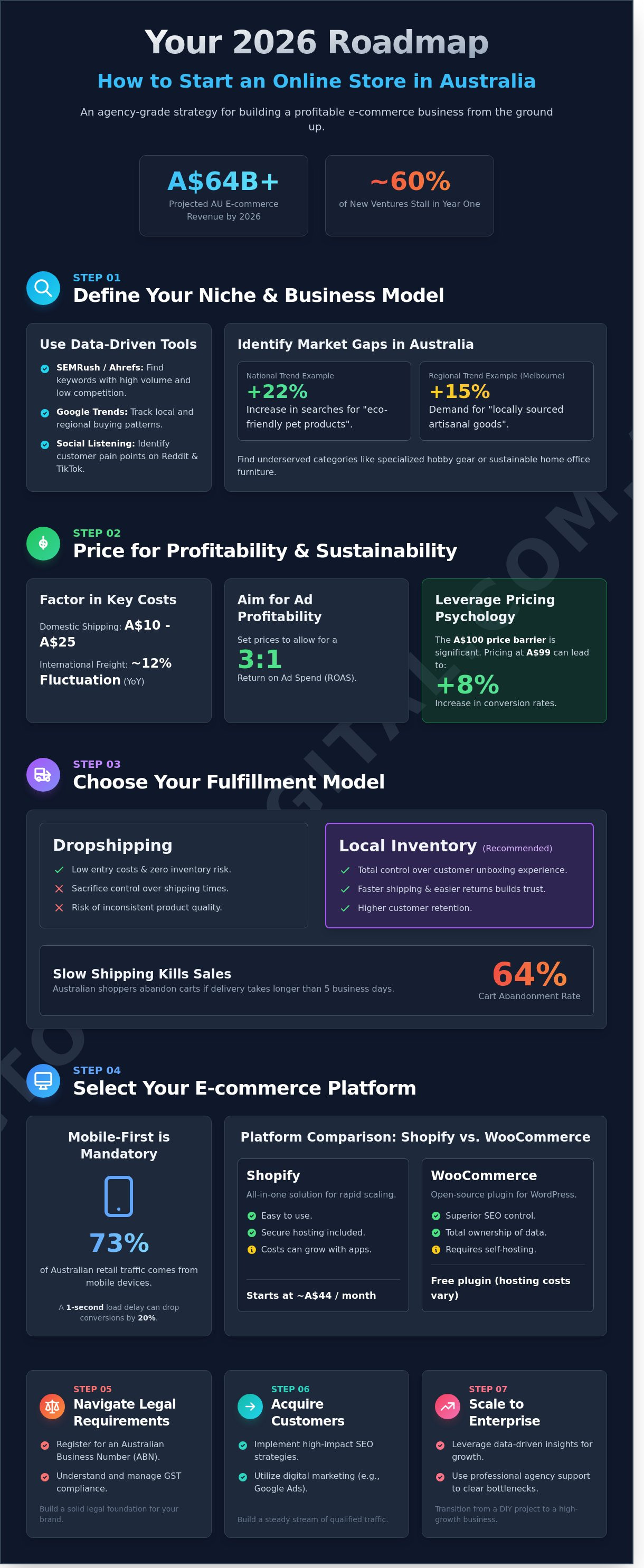
By the end of 2026, Australian e-commerce revenue is projected to surpass A$64 billion, yet nearly 60% of new digital ventures will stall before their first anniversary because of technical overwhelm. You already know that building a digital presence is the most effective way to grow your business, but the fear of picking the wrong platform or messing up your GST obligations can be paralyzing. If you feel stuck before you've even made your first sale, don't worry; we've got you covered.
This comprehensive roadmap simplifies the process of how to start an online store by focusing on tangible results rather than confusing jargon. We provide a clear, professional strategy to help you secure your ABN, select a high-quality platform, and implement marketing tactics that actually turn traffic into customers. From your initial product niche to advanced lead generation, you're about to gain a step-by-step plan to put a powerful agency-grade strategy behind your new business venture.
Key Takeaways
- Identify high-demand niches and validate your product ideas for 2026 using advanced social listening and keyword research techniques.
- Navigate essential Australian business requirements, including ABN registration and GST compliance, to build a solid legal foundation for your brand.
- Learn how to start an online store using a mobile-first approach on platforms like Shopify or WooCommerce to capture the modern Australian consumer.
- Build a steady stream of qualified traffic by integrating high-impact SEO and digital marketing strategies that turn visitors into loyal customers.
- Transition from a DIY project to a scalable enterprise by leveraging data-driven insights and professional agency support to clear growth bottlenecks.
Defining Your Business Model and Product Niche for 2026
Starting a digital business in 2026 requires more than a spark of inspiration; it demands a data-backed strategy that prioritizes profit from day one. When you're learning how to start an online store , the first step is choosing a model that balances risk with scalable reward. You need to begin by understanding e-commerce models to decide if you'll sell directly to consumers (B2C) or target the business sector (B2B). Sound confusing? Don't worry, we've got you covered. We've seen that the most successful ventures don't just sell products; they solve specific problems for a defined audience.
Profitable niches aren't found by guessing. Use professional tools like SEMRush or Ahrefs to find "low-hanging fruit" where search volume is high but competitor authority is low. For instance, a 2024 market report showed a 22% increase in searches for eco-friendly pet products within Australia. Validate your idea through social listening on platforms like TikTok and Reddit. If shoppers are complaining about 14-day shipping times or poor quality from international giants, you've identified a gap. Put an agency behind your business early by using these insights to build a brand that addresses these local pain points directly.
Market Research in the Australian Landscape
Google Trends is your best friend for tracking local buying patterns. In the Melbourne area, particularly the Mornington Peninsula, data from 2025 showed a 15% rise in demand for locally sourced artisanal goods. Don't just look at national data. Analyze regional competitors to see what they're missing. Underserved categories in the Australian market often include specialized hobby gear, high-end sustainable home office furniture, or even unique service-based models like designer fashion rental. For example, a store could let customers explore Maxi Dresses for special events without the high purchase price. Identifying these gaps allows you to drive a steady stream of qualified leads to your site.
Pricing for Profitability and Sustainability
Your pricing must be bulletproof to survive the Australian market. Factor in A$10 to A$25 for domestic shipping and account for international freight costs, which fluctuated by 12% last year. Set your price points to allow for a 3:1 return on Google Ads investment. Australian consumers often hit a psychological barrier at the A$100 mark; staying at A$99 can increase conversion rates by 8% based on recent retail studies. We tailor our strategies to ensure your margins can support aggressive growth without thinning out your capital.
Choosing your fulfillment model is a pivotal decision that impacts your long-term results. You have two primary paths:
- Dropshipping: This offers low entry costs and zero inventory risk. However, you often sacrifice control over shipping times and product quality.
- Local Inventory: Holding stock in an Australian warehouse gives you total control over the "strongest customer touchpoint": the unboxing experience.
A 2025 logistics survey found that 64% of Australian shoppers abandon their carts if delivery takes longer than 5 business days. If you want to grow your business quickly, local inventory usually wins on customer retention. While dropshipping might seem easier, holding stock allows for faster shipping and easier returns. This builds the trust necessary to turn a first-time buyer into a loyal customer. When you're figuring out how to start an online store , remember that your fulfillment choice dictates your reputation. We focus on achieving business growth by helping you pick the model that aligns with your specific budget and 2026 sales targets.
Choosing the Right E-commerce Platform for Growth
Your choice of platform serves as the foundation for everything your business will achieve. When you are researching how to start an online store, the sheer volume of options can feel overwhelming. Don't worry; we've got you covered. The decision usually comes down to three paths: Shopify, WooCommerce, or a custom-built solution. Each has distinct implications for your profit margins and operational efficiency.
Site speed is the primary conversion killer in modern Australian e-commerce. Google data indicates that a one-second delay in mobile load times can impact conversion rates by up to 20%. Australian e-commerce statistics from 2023 show that 73% of retail traffic now originates from mobile devices. If your platform isn't optimized for a mobile-first 2026 consumer, you're leaving money on the table. A high-performance site ensures your brand remains a strongest customer touchpoint rather than a source of frustration.
Shopify vs. WooCommerce: Which Fits Your Business?
Shopify is the leading all-in-one solution for brands that want to scale rapidly without managing server architecture. It's a reliable partner that handles security and hosting for you. Basic plans start at approximately A$44 per month, but costs can grow as you add premium apps. WooCommerce offers superior SEO control and flexibility for content-heavy brands using WordPress. While the plugin is free, Australian businesses often spend between A$2,500 and A$6,000 annually on quality hosting, security patches, and developer maintenance. This step-by-step guide provides additional context on balancing these initial setup costs against long-term growth goals.
The Case for Custom E-commerce Development
Off-the-shelf templates eventually limit your business growth. Once a brand surpasses A$1.5 million in annual revenue, the need for unique user experiences (UX) and specialized functionality often requires a custom approach. Custom development allows for seamless integration of local Australian inventory systems or complex CRM management tools via dedicated APIs. This path ensures your digital storefront is tailored specifically to your operational needs. It removes the "bloat" often found in generic themes, which directly improves site speed and search engine rankings.
Growth isn't just about the platform; it's about the ecosystem you build around it. Integrating essential tools for email marketing, product reviews, and loyalty programs is vital for retention. Tools like Klaviyo or Okendo can increase customer lifetime value by 25% within the first six months of implementation. Effective marketing strategies require these systems to talk to each other perfectly. If the technical side of how to start an online store feels like a hurdle, putting an agency behind your business can turn these complex integrations into a streamlined sales engine. Focus on your products while the right technology handles the heavy lifting.
Navigating Legal Requirements and Logistics in Australia
Setting up the legal framework for your business is the most critical step in learning how to start an online store that lasts. You cannot skip the paperwork if you want to protect your personal assets and build a brand that Australian consumers trust. Most successful digital retailers begin by consulting the Australian Government's guide to starting a business to ensure they meet every regulatory milestone from day one. This foundation allows you to focus on growth rather than legal headaches.
Every Australian business needs an Australian Business Number (ABN). This 11-digit identifier is essential for tax purposes and for registering a .com.au domain name. You can apply for an ABN through the Australian Business Register at no cost. If you're operating as a company rather than a sole trader, you'll also need an Australian Company Number (ACN). While it sounds complex, we've got you covered. These identifiers ensure you can open a business bank account and claim the business expenses that lower your year-end tax bill.
Compliance and Tax Essentials
Goods and Services Tax (GST) is a 10% tax on most goods and services sold in Australia. You must register for GST if your annual business turnover is A$75,000 or more. Even if you expect to earn less in your first year, voluntary registration allows you to claim GST credits on your initial inventory and equipment purchases. To keep things simple, configure your ecommerce platform to handle automated tax calculations. This ensures the 10% is added correctly at checkout based on the customer's location, saving you hours of manual accounting every month.
Australian Logistics and Payment Gateways
Logistics can make or break your reputation. Australia Post is the reliable choice for reaching 12.7 million delivery points across the country, especially in regional areas. For businesses focused on urban centers, Sendle offers carbon-neutral delivery and often beats standard post rates for small parcels. If you're shipping high-value items, StarTrack provides the speed and tracking precision that premium customers expect. Optimising the "Last Mile" experience is about more than just speed; it's about providing clear tracking notifications that keep your customers informed until the package hits their doorstep.
When considering how to start an online store, your choice of payment gateway directly impacts your conversion rate. Stripe and PayPal are the industry leaders, typically charging around 1.75% plus A$0.30 per transaction for domestic cards. However, the Australian market has a high adoption rate for Buy Now, Pay Later (BNPL) services. Integrating Afterpay or Zip can increase your average order value by as much as 18% as it gives customers the flexibility to spread costs. Put an agency behind your business logic by offering the payment methods your specific audience actually uses.
Finally, your store must include three essential legal pages: a Privacy Policy, Terms of Service, and a Refund Policy. Under Australian Consumer Law, you cannot simply say "no refunds" if a product is faulty or doesn't match the description. Your refund policy must clearly state that customers are entitled to a repair, replacement, or refund for major failures. These pages aren't just legal requirements; they are your strongest customer touchpoint for building the transparency that leads to repeat sales. Clear policies reduce customer friction and protect your business from unnecessary disputes.
Building Your Customer Acquisition Strategy (SEO & Ads)
Launching a visually stunning website is a major milestone, but a beautiful store is useless if nobody sees it. Without a steady stream of qualified traffic, your digital shopfront is effectively a billboard in the middle of the outback. You need a deliberate strategy to pull customers in. This is a critical stage in learning how to start an online store that actually generates revenue rather than just sitting idle. At Octopus Digital, we believe your website should be your strongest customer touchpoint, and that requires a mix of immediate wins and long-term growth.
SEO acts as your foundation for long-term, organic brand authority. According to 2023 data from BrightEdge, organic search drives 53% of all website traffic across the internet. While it takes time to climb the rankings, the results compound. You aren't just buying clicks; you're building a digital asset. To complement this, Google Ads provides the immediate lead generation and sales needed to keep cash flow moving. In Australia, Google holds over 94% of the search engine market share as of late 2023. If you aren't appearing there, you're invisible to the vast majority of local shoppers.
Social media management rounds out this strategy by building community and trust. A 2024 report from We Are Social found that 81% of Australians are active social media users. These platforms aren't just for ads; they're where customers verify your brand's legitimacy. Seeing active engagement and professional content gives shoppers the confidence to hit the "buy" button on a new store. If the technical side sounds confusing, don't worry, we've got you covered.
E-commerce SEO: Ranking Your Products
Success starts with high-quality product titles and meta descriptions. You must include your primary keywords while writing for humans to ensure high click-through rates. Category pages are equally vital because they target broad, high-volume search terms that bring in shoppers who haven't decided on a specific product yet. Strategic internal linking allows search engine bots to discover deeper product pages while distributing link equity across your entire site structure. As you refine your plan for how to start an online store, treat SEO as a non-negotiable investment in your brand's future.
Paid Traffic: Scaling with Google Ads
Google Shopping campaigns are the gold standard for e-commerce because they show your product image, price, and store name directly in the search results. This intent-based traffic is highly likely to convert. To maximise your budget, use remarketing strategies to win back the 70% of shoppers who typically abandon their carts. By showing targeted ads to people who have already interacted with your brand, you stay top-of-mind and drive them back to complete the purchase.
When allocating your first A$1,000 of ad spend for maximum ROI, we recommend a structured split:
- A$600 for Google Shopping: Focus on your top 20% of products by margin or popularity to drive immediate sales.
- A$250 for Remarketing: Target users who visited your site but didn't buy, using dynamic ads that show the exact products they viewed.
- A$150 for Search Ads: Bid on high-intent "buying" keywords or your own brand name to capture customers ready to commit.
Ready to turn your traffic into a reliable sales engine? Put an agency behind your business and let our experienced team drive the results you need.
Scaling from Hobby to High-Growth Enterprise
Many entrepreneurs learning how to start an online store reach a plateau once they hit their first consistent sales milestones. Managing inventory, customer service, and digital marketing manually becomes a bottleneck that prevents real expansion. Transitioning from DIY management to an agency-backed model allows you to focus on high-level product development while experts handle the technical growth. It's the difference between owning a side project and running a serious Australian brand.
Before you can scale your marketing or sales, however, it's crucial to ensure your underlying technology can keep up. Slow computers, network issues, or data security risks can halt growth just as effectively as a poor marketing strategy. For small businesses and home offices, having professional IT support is a key part of building a scalable foundation; you can read more about establishing robust systems for your venture.
Google Analytics 4 (GA4) provides the roadmap for this transition. By June 2024, Australian e-commerce businesses using advanced event tracking saw a 15% average increase in checkout completions compared to those relying on basic setups. We use this data to identify exactly where your customers drop off. Whether it's a slow-loading shipping calculator or a confusing mobile menu, we find the friction and fix it. Data removes the guesswork from your business decisions.
At Octopus Digital, we operate under a specific philosophy: your website is your strongest customer touchpoint . It isn't just a digital business card; it's a 24/7 salesperson that needs to perform at its peak every second. When you put an entire agency behind your business, you gain access to specialists who understand the local market. We've helped local brands double their traffic within six months by shifting from generic tactics to aggressive, data-driven strategies. We've got you covered throughout the entire scaling process.
Optimising Your Conversion Rate (CRO)
Scaling requires more than just driving more traffic; it requires converting that traffic more efficiently. A/B testing your checkout process reveals small frictions that cost thousands in lost revenue. For instance, data shows that removing just one unnecessary form field can increase completions by 10%. We use heatmaps to see exactly where customers click and where they lose interest. This visual data informs how we improve product photography and descriptions. High-resolution, multi-angle shots are essential for building trust, especially when selling items over A$150 where customers demand more visual proof before committing.
Partnering for Success
While templates are a helpful starting point when you're first figuring out how to start an online store , they eventually limit your speed and SEO potential. Custom web design outperforms templates because it's built for specific user journeys and rapid load times. A site that loads one second faster can see a 7% jump in conversions, which translates to significant revenue as your volume grows. Mapping out your digital strategy is the first step to sustainable scaling. Book your free discovery call with Octopus Digital today to see how we can transform your store into a high-growth enterprise. We dive deep into your business to ensure every marketing dollar returns maximum sales.
Take Your Australian E-commerce Brand to the Next Level
Success in the 2026 digital landscape requires more than just a great product. You've now seen how prioritizing a future-proof niche and navigating local ABN requirements sets the foundation for long-term growth. Mastering how to start an online store means balancing technical logistics with a high-impact customer acquisition strategy. Whether you're scaling a side project or launching a national brand, your website remains your strongest customer touchpoint. It needs to do more than look good; it has to turn browsers into buyers through strategic design and site speed.
Our experienced team on the Mornington Peninsula specializes in results-driven SEO and Google Ads strategies that turn traffic into measurable revenue. We don't just build sites; we create 100% custom-tailored, high-converting platforms designed specifically for the Australian market. Don't let the complexity of technical SEO or ad management hold your vision back. We've got you covered with data-backed methods that produce tangible sales figures. Put an agency behind your business and watch your conversion rates climb.
The Australian market is waiting for what you have to offer. It's time to stop planning and start scaling your success.
Frequently Asked Questions
How much does it cost to start an online store in Australia?
Starting an online store in Australia typically costs between A$500 and A$5,000 for the initial setup phase. Fixed costs include a domain name at A$30 per year and platform subscriptions starting around A$45 monthly. If you want a professional result that drives sales, you should budget for custom design and initial marketing. We've got you covered by helping you allocate your budget toward the most effective growth channels.
Do I need an ABN to sell products online in Australia?
You must have an Australian Business Number (ABN) if you intend to trade as a business rather than a hobby. Most Australian payment gateways, like Stripe or Airwallex, require an ABN to process your sales. Registering is free through the Australian Business Register and helps you claim GST credits if your turnover exceeds A$75,000. This legal step ensures your business is recognised by the ATO and builds trust with your local customers.
Which e-commerce platform is best for beginners in 2026?
Shopify remains the best e-commerce platform for beginners in 2026 due to its intuitive interface and local Australian support. It integrates seamlessly with Australia Post and local payment providers. While WooCommerce offers more control, Shopify’s all-in-one approach means we've got you covered when it comes to security and hosting. It allows you to focus on sales rather than technical maintenance, which is vital for new business owners.
How long does it take to build a professional e-commerce website?
A professional e-commerce website usually takes between 4 and 12 weeks to build and launch. A simple DIY setup might take 14 days, but a high-quality site with SEO and custom integrations requires more time. We focus on building your strongest customer touchpoint correctly from day one to ensure long-term growth. This timeframe allows for thorough testing, product uploads, and payment gateway configuration to ensure a smooth customer experience.
Can I start an online store without holding any inventory?
Yes, you can start an online store without inventory by using a dropshipping or print-on-demand model. In this setup, your supplier ships products directly to your customers after a sale is made. This reduces your upfront risk, though profit margins are often 15% to 20% lower than traditional wholesale models. It's an effective way to test product-market fit before investing in bulk stock for your Australian warehouse.
What is the best way to drive traffic to a new online store?
The most effective way to drive traffic is a combination of Search Engine Optimisation (SEO) and targeted Google Ads. SEO provides long-term organic growth, while paid ads generate immediate sales from day one. Focus on high-intent keywords to ensure you aren't just getting clicks, but are attracting ready-to-buy customers. A balanced strategy ensures your brand remains visible across both search results and social media platforms like Instagram.
Is it better to DIY my online store or hire an agency?
DIY is suitable for testing a concept on a micro-budget, but hiring an agency is better for scaling a serious business. When you put an agency behind your business, you gain access to expert designers and marketers who understand how to start an online store that actually converts. Professionals ensure your site is fast, secure, and optimised for Australian consumers, saving you hundreds of hours of trial and error.
What are the most common mistakes when starting an online store?
Common mistakes include ignoring mobile responsiveness and failing to set up a clear shipping strategy. About 60% of Australian shoppers abandon carts due to unexpected delivery costs at checkout. Another error is neglecting SEO during the phase of how to start an online store, which forces you to spend more on paid ads later. Starting with a clear plan prevents these technical and financial hurdles from slowing your growth.